Whether you are planning to have a "Stay-Cation" in your own neck of the woods or maybe you are a more adventurous person that wants to tour distant lands, I found a web site that lists some really great spots to see.
Use this list to plan your next time off and enjoy the "Experience" of being in the midst of great architecture.
Here is the link:
http://www.latimes.com/travel/la-tr-sf31-2010jan31-pg,0,6364853.photogallery
Click on the "ReTweet" button below and follow me on twitter. I am LaneArch there.
Friday, January 29, 2010
Monday, January 25, 2010
How Haiti Earthquakes Destroyed Buildings
Check out the video above to see the reason why the earthquakes in Haiti caused so much devistation. You can also view this video at my new vlog at
http://www.YouTube.com/LarryLaneTV
Listen to the podcast at http://www.blogtalkradio.com/LaneArchitecture to hear more reasons why this tragedy happened and how we can help prevent it from happening again in the future - anywhere!
I also share a story about how a man in the USA made a special trip to Haiti to personally save the life of one Haitian man that once saved this American only 5 years earlier.
See you there at
http://www.blogtalkradio.com/lanearchitecture/2010/01/25/tragedy-in-haiti-also-shares-blessings
Click on the "ReTweet" button below and follow me on twitter. I am LaneArch there.


Wednesday, January 20, 2010
How is NYC Overcoming the Recession?

Mike Bloomberg gave his State of the City (NYC) Address today. He is doing a good job at bringing the City into the new technologically savvy world. In his address, he covered four very key points. They were:
1. How can we help those who’ve been hit hardest by these tough times?
o To help those about to lose their homes to foreclosure, his administration is implementing some things that no other city in the nation has done. He is creating credit unions for home owners to get more favorable loans, creating checking accounts that have no minimum balance penalties or hidden fees, and giving grants to home owners so they can qualify to refinance their mortgages.
o The City will also be giving out bracelets with GPS devices to families with disabled family members. This is to protect them from getting lost and hurt.
2. How can we make it easier to open and grow small businesses?
o To help open and grow small businesses, his administration is making it easier for businesses to start up with less red tape. This can save entrepreneurs three months of waiting, allow hiring to begin 3 months earlier, and put 3 extra months of income into their businesses.
3. How can we connect Black and Hispanic young people to the opportunities and support that can lead them to success?
o To help minorities, they are supporting youth risk centers that help young teens learn new trades and learn how to be better parents of their newborns.
4. How do we find new ways to stretch every dollar to the limit?
o To stretch every dollar to the limit, he already has put into place a 311 call center where New Yorkers can call in to find out information about where they can receive certain services. Now, he is expanding this by creating on point of contact where people can register, fill out, and file certain forms that would normally require people to go to many different locations and stand in many different lines to get the same things accomplished. It would be really great if he could allow architects to file on-line their drawings and filing documents instead of needing to hire expediters to stand in lines at the New York City Department of Buildings to meet with plan examiners and other municipal officials.
Mayor Bloomberg referred the citizens of NYC as customers of the City. He said that in this global high tech world, it is getting more challenging for cities to keep their citizens “customers” from moving out. He wants to improve customer services so people will not want to leave NYC.
In a nut shell, here is a concluding quote from his address:
"The spirit of innovation and enterprise that fuels the Big Apps competition is encoded in the very DNA of this City. And it's that spirit that gives me confidence we can meet all the challenges we face, including those highlighted by our four questions: helping struggling New Yorkers find jobs and financial security, helping small business owners open their doors, helping our most troubled, at-risk young people build their futures, and the future of our City. And helping City government provide better service - at lower costs.”
Click on the "ReTweet" button below and follow me on twitter. I am LaneArch there.
Why Did Scott Brown Win the Mass Senate Race?

Scott Brown was born in a family whose parents divorced when he was only one year old. He spent some time living with his aunt during the unsteady times of this mom and dad’s well being. In fact, for a period of time, his mom had to resort to welfare to just make ends meet.
At a young age, Scott was arrested for shop lifting record albums in a local store. The judge asked him what he thought that his siblings would think of him if they had to see him play basketball while in prison. This question and the 1500 word essay that the judge required him to write about his bad choice of stealing was his penalty and his sobering remedy to be more concerned about others around him.
Scott joined the Lion’s Club and later joined the National Guard.
Scott became the “regular guy.”
So what made Scott Brown the winning candidate for the Republican candidate for the U.S. Senate? Even more important, what helped Scott Brown win the election for the U.S. Senate seat that was taken by the long standing democrat Senator Ted Kennedy of 30 years plus?
It appears that Scott won the election last night because the community was turned off by being represented by a Democrat fill-in person that took for granted that her position would be protected since the Commonwealth of Mass. Was seemly always democrat. It seemed that the people of that state resented that they were to be represented by someone that represented a social medical agenda that the state endorsed under a republican governor Mitt Romney and found that their decision was too costly and too inefficient. They seemed to want no more of this on a federal level.
What can we learn from this on an architectural level?
My take is that we need not take for granted that stock plans, designers, and builders can provide a sufficient end product for our spacial needs at our church designs, office layouts, or our home renovations. It might be cheaper to hire a builder to construct one of these without well thought out designs by an architect, but in the long run, we cannot take for granite that they will be able to provide the design services that will truly reflect our spacial needs.
Don’t waste your money or time. Hire an architect. It doesn’t have to be my firm, Lane Architecture + Design. Find an architect that has been published and has an extensive testimonial list that recommends their services. If they can provide a design that will help your organization experience the type of business and lifestyle you desire – hire them immediately. It will be the best thing you could do for yourself or your company.
Click on the "ReTweet" button below and follow me on twitter. I am LaneArch there.
Monday, January 18, 2010
Do you live in a house that was built before 1978?
Above is a video of me introducing an expert about lead paint. He shares how contractors can be fined over $30,000 per day per incident after April 22, 2010 if they do not follow the guidelines that the EPA has put into law.
Tune into the podcast at
http://www.blogtalkradio.com/lanearchitecture/2009/12/21/new-federal-laws-affecting-home-owners-and-contractors
Click on the "ReTweet" button below and follow me on twitter. I am LaneArch there.
Tuesday, January 12, 2010
Do You Want to Avoid Suprises During Home Renovations?

Getting to that extraordinary place has often required homeowners to endure an endless number of challenges. We all have heard of have lived through horror stories during a home renovation.
* Difficulties obtaining permits
* The contractor disappears in the middle of tearing out everything.
* Neighbors complain about dust and noise coming from your home
* Cost over-runs
* Construction Delays
All of these issues (and many more) stack upon each other until you feel that there is no painless way out.
This journal is designed to help you navigate through the design and construction process by using a simple seven step method. I believe that there is immense value in each of the seven sections in this journal.
Download a free copy of this journal by clicking on the book cover icon on the right side of this blog page.
You and your family will be glad that you did.
If you like this article and would like to keep informed about other important news of the day, please subscribe to this blog by clicking on the buttons along the right column.
Click on the "ReTweet" button below and follow me on twitter. I am LaneArch there.
Thursday, December 31, 2009
Fort Worth New Museum of Science and History Needs to Go Back to the Drawing Board
While visiting my family in Fort Worth during the Christmas holidays, I went to the Cultural Center where the town has a cluster of notable buildings. The city recently finished rebuilding the Museum of Arts and Science that was designed by Legorreta + Legorreta and I was curious to see how it turned out.
What a disappointment!
Most of the visitors will be arriving to the cultural center via University or Montgomery Street after taking Interstate 30 from Dallas or from the outer edges of Fort Worth. This museum’s loading dock hides all but the top part of the Cowgirl Hall of Fame. The back side of the new museum that is finished with EIFS is what one will see when approaching the cultural center on Montgomery Street.
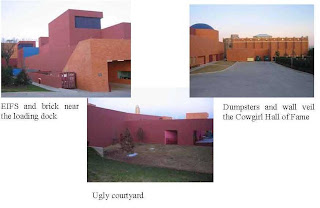
EIFS is a cheap exterior finish that is constructed with sprayed on textured plastic upon a nylon mesh that is glued upon Styrofoam. If you thump it with your fingers, you will hear a hollow echo. Even though the museum has only been open for a few weeks, the ground crew has easily managed to damage this exterior finish with their trimming tools. You can find gashes on the EIFS walls that expose the Styrofoam near the ground.
Even the architect wanted to hide this ugly side of the building. He added rows of shrubs on top of a long narrow hill (a berm) that acts as a visual barrier. There is a large outdoor area on this side of the building that could be used as an outdoor amphitheater, but a lot of work will need to be done to make that sparse area more inviting.
To get to the front entrance, the visitor must turn on West Lancaster Avenue and then onto Gandy Street. Gandy Street is flanked by a huge parking structure that is currently under construction and an even larger parking lot. The front entrance of the museum is also on Gandy Street. But, to find the front entrance is a challenge.
This awkward cube looks like it should be the main entrance when you approach the building, but it is not...

The large brick cube with the clear glass clearstory that is along the same street wall as the Cowgirl Hall of Fame first appears to be the logical destination to enter the museum. But it is not. The only purpose of this imposing mass is to house a rusty scaled down model of an oil derrick. Not a big attraction for the visitors.
The Urban Cube is that structure at the end of a long unaccessible road..

The main entrance is hidden behind the brick cube. In fact, the four simple glass doors are placed in its own cube that is cleverly named the “Urban Lantern.” This entrance is at the end of the axis created by Burnett Tandy Drive that passes between the rows of live stock barns. Except for a few spots along the curb, there is no parking available on this road. In fact, this road will be closed to vehicular traffic during the Fat Stock Show. This is the annual community event that attracts the majority of visitors into this area. During other times of the year, I guess that the museum is counting on the the visitors to arrive via school bus that will unload scores of children at this front.
Most of the visitors who drive their own cars to this museum will park in one of the two parking areas that are on either side of Gandy Street. Entering through the obscure side entrance near the IMAX Theater would be the easiest route into the building – not the front entrance.
Some of the community leaders of Fort Worth really like this museum because it has its own unique architecture. They like the bold use of colors and the Mexican-American influence of style. These are good design elements to have in a cultural center if they are used with a purpose and with an order.
The Amon Carter Museum, Kimball Art Museum, Museum of Modern Art, Cowgirl Hall of Fame, Casa Manana, and the Will Rogers Memorial Coliseum are the cultural neighbors of this new museum that clearly have order.
One of these arches are not like the other...

The architect, Philip Johnson, provides order with his post-modern colonnade in front of the Amon Carter Museum. The building is placed upon one of the highest parts of the cultural center and looks down toward downtown Fort Worth much like the Acropolis. There is an elegant arch between the columns that emulate the arched roofs of the stock yard barns. He was very interested in creating an experience for the visitor. Be sure to read more about how experience based design is the best way to boost your profits in your office spaces in the book, “The Designed Office”http://www.MyDesignedOffice.com
The architect, Louis Kahn, provides order with his row of barrel vaults on the Kimball Art Museum. The arches on these vaults are also borrowed from the arched roofs found on the live stock barns nearby.
The architect, Tadao Ando, provides order with his stacked rectangular galleries in the plan of the Museum of Modern Art. He then provides some playful ovals to break up the grid. Mr. Ando studied the arches of its neighbor, the Kimbell Museum, and added similar barrel vaults in his design.
The Cowgirl Hall of Fame provides order with its reference to classic architecture, the Will Rogers Memorial Coliseum provides order with its art deco references, and the geodesic dome of the Casa Manana provides an obvious geometric order.
The Museum of Science and History, however, looks like it was designed by a committee. The mass of the building is a mismatched collection of geometric shapes that have haphazard offsets. It appears that the architect started with a bubble diagram to organize the various spaces and then handed it to the various department heads to determine their sizes. It would be very helpful if a grid was used to tie all of the geometric shapes together.
There are several pyramids on the roof that do not relate to anything else. Barrel vaults were used at the ceiling of various public spaces but their profiles are much like one would create if they used a simple circle template. They are certainly not reflecting the flat elegant arches of the other major buildings nearby. Instead, they appear to be designed by an amateur.
I have a lot of fond memories at the Museum of Science and History. When I visited it as a child, the museum was called the Children’s Museum. The museum offers a lot more things for young minds than it did when I was visiting it as a child. They now have the IMAX, interactive learning areas, and a large area for traveling shows.
The one thing that survived the redesign of the Museum of Science and History is the spirit of learning. Children and their family members will continue to come in large numbers to this new facility. Unfortunately, most visitors probably will not ever consider what is mentioned in this blog post.
For them, it will not matter if they were in a new museum or in a new shopping mall. For them, it is just a place to go and maybe learn something new.
But for me, it is important to have a well thought out design that earns its place near such great monumental architecture as its surrounding neighbors. For me, it needs to be more than just another destination.
You can also view a video of this area at my new vlog at
http://www.youtube.com/watch?v=l1pR7haYCd4
If you like this article and would like to keep informed about other important news of the day, please subscribe to this blog by clicking on the buttons along the right column.
Click on the "ReTweet" button below and follow me on twitter. I am LaneArch there.
What a disappointment!
Most of the visitors will be arriving to the cultural center via University or Montgomery Street after taking Interstate 30 from Dallas or from the outer edges of Fort Worth. This museum’s loading dock hides all but the top part of the Cowgirl Hall of Fame. The back side of the new museum that is finished with EIFS is what one will see when approaching the cultural center on Montgomery Street.

EIFS is a cheap exterior finish that is constructed with sprayed on textured plastic upon a nylon mesh that is glued upon Styrofoam. If you thump it with your fingers, you will hear a hollow echo. Even though the museum has only been open for a few weeks, the ground crew has easily managed to damage this exterior finish with their trimming tools. You can find gashes on the EIFS walls that expose the Styrofoam near the ground.
Even the architect wanted to hide this ugly side of the building. He added rows of shrubs on top of a long narrow hill (a berm) that acts as a visual barrier. There is a large outdoor area on this side of the building that could be used as an outdoor amphitheater, but a lot of work will need to be done to make that sparse area more inviting.
To get to the front entrance, the visitor must turn on West Lancaster Avenue and then onto Gandy Street. Gandy Street is flanked by a huge parking structure that is currently under construction and an even larger parking lot. The front entrance of the museum is also on Gandy Street. But, to find the front entrance is a challenge.
This awkward cube looks like it should be the main entrance when you approach the building, but it is not...

The large brick cube with the clear glass clearstory that is along the same street wall as the Cowgirl Hall of Fame first appears to be the logical destination to enter the museum. But it is not. The only purpose of this imposing mass is to house a rusty scaled down model of an oil derrick. Not a big attraction for the visitors.
The Urban Cube is that structure at the end of a long unaccessible road..

The main entrance is hidden behind the brick cube. In fact, the four simple glass doors are placed in its own cube that is cleverly named the “Urban Lantern.” This entrance is at the end of the axis created by Burnett Tandy Drive that passes between the rows of live stock barns. Except for a few spots along the curb, there is no parking available on this road. In fact, this road will be closed to vehicular traffic during the Fat Stock Show. This is the annual community event that attracts the majority of visitors into this area. During other times of the year, I guess that the museum is counting on the the visitors to arrive via school bus that will unload scores of children at this front.
Most of the visitors who drive their own cars to this museum will park in one of the two parking areas that are on either side of Gandy Street. Entering through the obscure side entrance near the IMAX Theater would be the easiest route into the building – not the front entrance.
Some of the community leaders of Fort Worth really like this museum because it has its own unique architecture. They like the bold use of colors and the Mexican-American influence of style. These are good design elements to have in a cultural center if they are used with a purpose and with an order.
The Amon Carter Museum, Kimball Art Museum, Museum of Modern Art, Cowgirl Hall of Fame, Casa Manana, and the Will Rogers Memorial Coliseum are the cultural neighbors of this new museum that clearly have order.
One of these arches are not like the other...

The architect, Philip Johnson, provides order with his post-modern colonnade in front of the Amon Carter Museum. The building is placed upon one of the highest parts of the cultural center and looks down toward downtown Fort Worth much like the Acropolis. There is an elegant arch between the columns that emulate the arched roofs of the stock yard barns. He was very interested in creating an experience for the visitor. Be sure to read more about how experience based design is the best way to boost your profits in your office spaces in the book, “The Designed Office”http://www.MyDesignedOffice.com
The architect, Louis Kahn, provides order with his row of barrel vaults on the Kimball Art Museum. The arches on these vaults are also borrowed from the arched roofs found on the live stock barns nearby.
The architect, Tadao Ando, provides order with his stacked rectangular galleries in the plan of the Museum of Modern Art. He then provides some playful ovals to break up the grid. Mr. Ando studied the arches of its neighbor, the Kimbell Museum, and added similar barrel vaults in his design.
The Cowgirl Hall of Fame provides order with its reference to classic architecture, the Will Rogers Memorial Coliseum provides order with its art deco references, and the geodesic dome of the Casa Manana provides an obvious geometric order.
The Museum of Science and History, however, looks like it was designed by a committee. The mass of the building is a mismatched collection of geometric shapes that have haphazard offsets. It appears that the architect started with a bubble diagram to organize the various spaces and then handed it to the various department heads to determine their sizes. It would be very helpful if a grid was used to tie all of the geometric shapes together.
There are several pyramids on the roof that do not relate to anything else. Barrel vaults were used at the ceiling of various public spaces but their profiles are much like one would create if they used a simple circle template. They are certainly not reflecting the flat elegant arches of the other major buildings nearby. Instead, they appear to be designed by an amateur.
I have a lot of fond memories at the Museum of Science and History. When I visited it as a child, the museum was called the Children’s Museum. The museum offers a lot more things for young minds than it did when I was visiting it as a child. They now have the IMAX, interactive learning areas, and a large area for traveling shows.
The one thing that survived the redesign of the Museum of Science and History is the spirit of learning. Children and their family members will continue to come in large numbers to this new facility. Unfortunately, most visitors probably will not ever consider what is mentioned in this blog post.
For them, it will not matter if they were in a new museum or in a new shopping mall. For them, it is just a place to go and maybe learn something new.
But for me, it is important to have a well thought out design that earns its place near such great monumental architecture as its surrounding neighbors. For me, it needs to be more than just another destination.
You can also view a video of this area at my new vlog at
http://www.youtube.com/watch?v=l1pR7haYCd4
If you like this article and would like to keep informed about other important news of the day, please subscribe to this blog by clicking on the buttons along the right column.
Click on the "ReTweet" button below and follow me on twitter. I am LaneArch there.
Subscribe to:
Comments (Atom)